How to Collect Digital Evidence from Phones and Devices: A Lawyer's Guide to Chain of Custody and Admissibility
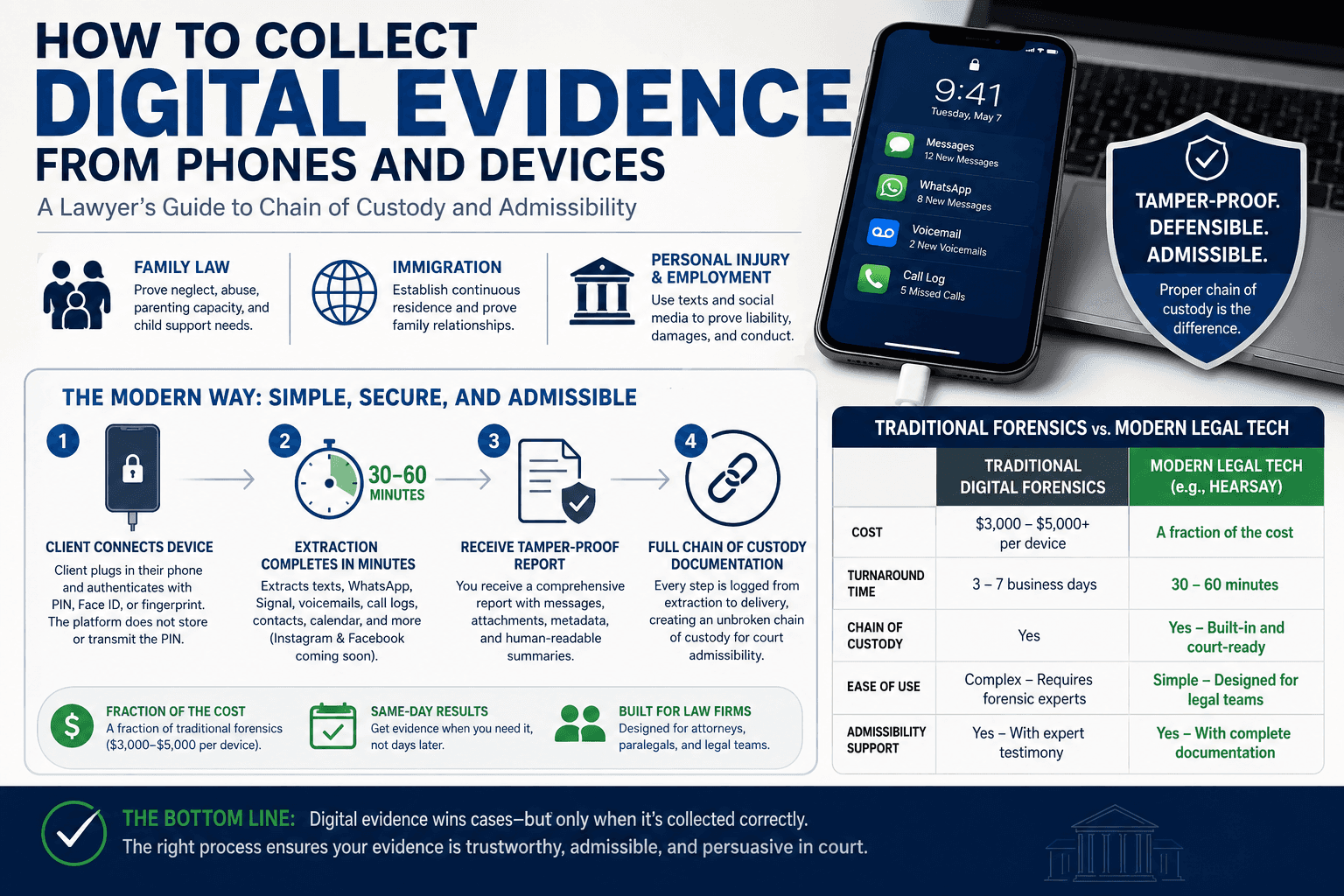
KEY TAKEAWAYS Q: What's the cheapest way to extract phone evidence without hiring a $5,000 forensic expert? A: Legal tech platforms like Hearsay extract text messages, WhatsApp, voicemails, and call logs in 30 to 60 minutes for a fraction of traditional forensics costs. The client plugs in their phone, enters their PIN, and you receive a tamper-proof report with full chain of custody documentation. Q: Can courts accept text message screenshots as evidence? A: Screenshots are unreliable because they lack metadata and can be easily edited. Courts strongly prefer electronically extracted messages with full timestamps and metadata. Proper chain of custody documentation is the difference between admissible and inadmissible evidence. Q: Which practice areas rely most on digital evidence collection? A: Family law custody disputes, immigration cases, personal injury litigation, and employment law matters all depend heavily on text, WhatsApp, and social media communications. Any case involving client communications is a candidate for digital evidence extraction. |
Your family law client's WhatsApp messages prove the other parent's neglect. Your immigration client needs text message timestamps to establish continuous residence. Your personal injury case hinges on the defendant's admission via text.
Digital evidence is everywhere in modern litigation. Yet extracting this evidence from a phone has traditionally been expensive and time-consuming. Digital forensics experts charge $3,000 to $5,000 per device with multi-day turnaround. Generic internet tools lack legal safeguards and chain of custody documentation. Screenshots are easily disputed in court.
This comprehensive guide covers how to collect digital evidence from mobile devices, what makes it admissible in court, and why modern legal tech platforms are changing how attorneys handle this critical task.
What Counts as Digital Evidence in Legal Cases?
Digital evidence encompasses any data stored on a computer, mobile phone, tablet, smartwatch, or cloud service that's relevant to a legal matter. This includes text messages, WhatsApp conversations, Instagram and Facebook DMs, Signal encrypted messages, call logs, voicemails, emails, photos with metadata, videos, GPS location data, browser history, and app activity logs.
The rise of mobile communications has transformed how evidence is generated. Decades ago, disputes were documented through letters and phone conversations. Today, they're documented through the apps in everyone's pockets. This creates both opportunity and risk for attorneys.
The opportunity is obvious: digital communications often contain admissions, agreements, schedules, and proof of relationships. The risk is equally clear: digital evidence can be fabricated, edited, or misinterpreted if not collected and presented correctly.
Why Is Digital Evidence Relevant Across Different Practice Areas?
Family law attorneys use text message patterns to establish parenting capacity, child support needs, and evidence of abuse. Immigration lawyers use WhatsApp timestamps to prove continuous residence and family relationships. Personal injury attorneys use defendant statements via text and social media to establish liability. Probate lawyers use family group texts to clarify testator intent and contest undue influence claims.
In nearly every field of law, someone's phone contains evidence that matters to the case. The attorney who collects this evidence correctly wins. The attorney who doesn't understand chain of custody and admissibility requirements loses.
What Makes Traditional Digital Forensics So Expensive and Slow?
When attorneys need phone evidence, they've traditionally turned to digital forensics specialists. These experts use specialized hardware and software to image mobile devices, recover deleted data, and generate expert reports. The process is thorough and defensible in court.
The cost, however, is substantial. Forensic specialists typically charge $3,000 to $5,000 per phone. For a family law case with devices from the client, the spouse, and a witness, you're looking at $9,000 to $15,000. For immigration matters involving multiple family members, costs spiral higher. Turnaround time is also problematic. Most forensic firms require three to seven business days to image a device, analyze the data, and prepare a report.
The alternative has been consumer-grade internet tools that extract messages quickly but offer zero legal oversight. These tools charge nothing or charge nominal amounts. But they provide no chain of custody documentation, no expert backing, no legal compliance features, and no support if opposing counsel challenges the evidence in court.
How Do Modern Legal Tech Platforms Extract Phone Evidence?
A new generation of legal tech platforms bridges the gap between cost-prohibitive forensics and unreliable consumer tools. These platforms are designed specifically for law firms and prioritize chain of custody, admissibility, and ease of use.
Hearsay, for example, operates on a workflow that any paralegal can manage without forensic training. The process unfolds in four straightforward steps.
Step 1: Client Connects Device
The client plugs their iPhone or Android phone into a computer via USB cable. They authenticate with their PIN, face ID, or fingerprint. The platform does not store or transmit the PIN. The platform does not copy the entire device. It reads data directly from the device in real time and extracts only what's needed.
Step 2: Extraction Completes in Minutes
In 30 to 60 minutes, the platform extracts text messages, WhatsApp conversations, Signal messages, voicemails, call logs, contact lists, calendar entries, and (coming soon) Instagram and Facebook DMs. Every message includes full metadata: sender, recipient, timestamp, message ID, and any attachments. Nothing is edited. Nothing is deleted. Every piece of data captured is exactly as it appears on the device.
Step 3: Client Searches and Selects Relevant Evidence
The extracted data appears in a searchable interface. The client can filter by keyword, phone number, contact name, date range, or message type. This is critical for privacy. If the extraction captured 5,000 personal messages, the client can select only the 50 that are relevant to the case. Opposing counsel only receives what's legally required, not the client's entire personal phone.
Step 4: Attorney Receives Tamper-Proof Report
The attorney receives a professional report that includes all selected evidence along with complete chain of custody documentation. The report shows the device model, iOS or Android version, extraction date and time, extraction method, who performed the extraction, and forensic certification. The report is digitally signed to prevent tampering. This report is directly admissible in court.
What Types of Evidence Can Be Extracted?
Modern extraction platforms capture a comprehensive range of digital communications. The actual evidence delivered to opposing counsel depends on what's relevant to the case and what the client consents to disclose.
Evidence Type | Typical Applications |
Text Messages (SMS) | Custody disputes, injury admissions, contract formation, harassment documentation |
International cases, immigration residence proof, family communications | |
Call Logs & Voicemails | Communication patterns, harassment, witness credibility, threats |
Photos & Videos with Metadata | Injury documentation, timestamps, location metadata, damage photos |
Social Media DMs (Coming Soon) | Instagram, Facebook, TikTok direct messages for evidence |
Can Text Messages Be Used as Evidence in Court?
Text messages are absolutely admissible in court. But admissibility depends on meeting three specific requirements: authentication, relevance, and lawful collection.
Authentication is the most critical requirement. The party introducing the text must prove that the message came from the person they claim it came from, at the time they claim it was sent. Courts don't accept just a name on the screen. They want proof. Extracted data with phone numbers, full message threads, timestamps, and metadata proves authentication. Screenshots fail this test because anyone can photoshop a screenshot.
Relevance means the text directly relates to the case. A WhatsApp about a travel date in an immigration case is relevant. A casual text about weekend plans is not.
Lawful collection means the evidence was obtained legally without violating the opposing party's rights. This is where chain of custody becomes critical. If you extracted messages from the client's own device with the client's consent, collection was lawful. If you accessed someone else's device without consent, the evidence is inadmissible and you have serious problems.
Why Are Screenshots Unreliable as Court Evidence?
Many attorneys have submitted screenshots of text messages as evidence. Some courts accept screenshots if they are properly authenticated. But screenshots are inherently vulnerable to challenge.
A screenshot captures only what appears on a screen at one moment. It shows no metadata. It shows no message ID. It shows no unique identifiers. And critically, it can be edited using basic tools in seconds. Any opposing counsel can argue that the screenshot was edited before trial.
When you introduce a screenshot, you're inviting challenge. Opposing counsel will ask your client to testify about what they remember seeing. They'll cross-examine about editing. They'll argue the screenshot is hearsay. You're fighting an uphill battle.
When you introduce extracted data with full metadata, timestamps, device information, and chain of custody documentation, the details are easy to enter into evidence. Courts accept this form of evidence routinely because it's tamper-evident and complete.
What Is Chain of Custody and Why Does It Matter for Digital Evidence?
Chain of custody is the chronological record of everyone who handled evidence and when. For digital evidence, it documents exactly who extracted the data, what method was used, when extraction occurred, what system performed the extraction, whether the data has been altered since extraction, and who accessed the data afterward.
A tamper-proof extraction report includes all this information. It proves that on a specific date and time, the client plugged in their device, the extraction software ran without errors, and the resulting data has not been modified. If months later you present that same data to opposing counsel, the report proves the data is identical to what was extracted.
Without chain of custody documentation, opposing counsel will attack the evidence. How do you know the messages weren't edited after extraction? How do you know the dates are accurate? How do you know the data came from the claimed device? These questions are legitimately asked if you can't document the chain of custody.
With chain of custody documentation, the answers are clear. The evidence is defensible in court.
Which Legal Practice Areas Rely Most on Digital Evidence?
Digital evidence extraction is relevant across practice areas, but several specialties depend on it heavily.
Family Law and Divorce: Custody disputes center on parenting patterns documented through text messages. Child support arguments involve financial communications. Infidelity and fault-based divorce claims rest on WhatsApp evidence.
Immigration: Travel dates and residence proof depend on WhatsApp timestamps and messages to family abroad. Spousal relationships and family reunification cases require extracted messages showing genuine relationships.
Personal Injury: Defendants communicate about accidents via text. Injured parties document recovery through social media. Defendants sometimes admit liability without realizing they're texting.
Probate and Estate: Text messages clarify what the deceased really intended. Family group chats show undue influence or lack thereof. Disputes over inheritance are resolved by extracted messages proving intent.
Harassment and Restraining Orders: Threats and harassing messages are extracted with full timestamps and sender verification.
How Much Does Digital Evidence Collection Actually Cost?
Cost is a legitimate concern when evaluating how to collect digital evidence. Traditional forensics is expensive. Consumer tools are cheap but legally unreliable. Legal tech platforms offer a middle ground.
A traditional forensics expert charges $3,000 to $5,000 per phone. If you have a family law case with devices from the client, the spouse, and a third party, you're spending $9,000 to $15,000 just for extraction. Add expert testimony and costs climb higher. Add more devices and costs become prohibitive.
Modern legal tech platforms cost a fraction of this amount per device. Hearsay and similar services cost significantly less and return results in under an hour instead of days. A paralegal can oversee the extraction without specialized training. The economics are dramatically better.
Beyond cost, faster extraction means faster case resolution. Evidence that would have taken a week to obtain now takes an hour. Cases can move forward without waiting.
What Are the Best Practices for Admissible Digital Evidence?
Extracting digital evidence is one step. Ensuring it's admissible in court requires attention to detail throughout the process.
Document Everything: Keep detailed records of who extracted the data, when extraction occurred, what device was involved, what extraction method was used, and who accessed the extracted data afterward. This is your chain of custody documentation.
Preserve Complete Metadata: Do not screenshot or manually copy messages. Use tools that extract all original metadata including device identifiers, timestamps, phone numbers, sender IDs, and message threading. This metadata is what makes evidence defensible against challenge.
Predefine Relevance: Before extraction begins, work with the client to identify what categories of messages are relevant. This protects privacy by ensuring only relevant data is disclosed to opposing counsel.
Use Legal-Focused Tools: Extraction platforms designed for law firms include chain of custody safeguards, tamper-proof reporting, audit trails, and legal support. Generic or consumer tools do not.
Obtain Written Consent: Before extracting data from your client's device, have them sign a written acknowledgment of extraction. This creates clear consent and becomes part of the chain of custody documentation.
Building Practice Growth Through Better Operations and Strategic Marketing
Investing in the right legal tech is about more than just case outcomes. It's about building a modern, efficient practice that attracts qualified clients. When you offer fast evidence collection, clear reporting, and professional processes, clients notice. Potential clients comparing you to competitors see a firm that operates at a higher standard.
This operational excellence combines powerfully with strategic marketing. An efficient practice paired with effective digital marketing and SEO creates sustainable growth. Qualified cases find you through organic search and paid advertising. You convert them quickly because your operations run smoothly. Your reputation grows because clients experience a professional firm.
Abogados NOW helps law firms build exactly this combination: integrated marketing strategy with operational excellence. Whether you're a family law firm, immigration practice, or personal injury shop, the formula works. Better tech, better marketing, more qualified cases, better growth.
Digital Evidence Collection Is Now Standard Practice for Competitive Firms
The days of treating digital evidence as a specialized, expensive service are ending. Modern legal platforms make evidence extraction affordable, fast, and legally sound. Firms that adopt these tools gain a competitive advantage. Clients expect it.
For law firms seeking to strengthen their online presence alongside their evidence capabilities, Abogados NOW provides tailored digital marketing strategies.
If you're still relying on screenshots, expensive forensics experts, or internet tools without legal safeguards, you're leaving money on the table. You're also exposing yourself and your clients to admissibility challenges in court.
Evaluate platforms based on cost, speed, metadata preservation, tamper-proof reporting, chain of custody documentation, and legal support. Choose tools designed specifically for law firms. Your paralegals, your clients, and most importantly, your judges will notice the difference.
Here are some other interesting articles:



Interested in using Hearsay to get your client's messages? Click the links below.
Need something else? Contact us at hello@usehearsay.com.

Hearsay
The All-in-One eDiscovery Collection & Review Platform.
SOC2 Type II
Platform
Practice Areas
© 2024-2026 No More Screenshots, Inc. All rights reserved.